
Onalaska Criminal History Checks
Start at city altitude. Onalaska Police Department owns its incident reports and media. The Coulee Region Joint Municipal Court owns its ordinance and traffic citation file. La Crosse County maintains current bookings and state court cases, while Wisconsin DOJ maintains the statewide criminal-history repository. No single result combines all those sources.
- Request an OPD report or recording through JustFOIA, by phone, or at the police counter.
- Call the joint municipal court with the name and date of birth for a lost citation or balance.
- Use the court's online plea route when the citation is eligible and appearance is not mandatory.
- Check the county inmate roster and WCCA for custody or a filed state charge.
- Use Wisconsin DOJ's WORCS service when a statewide repository response is needed.
Compare case numbers, dates, and agencies. A police report documents an allegation or response, while a court disposition records what happened to a charge. A mere name match is not enough to confirm identity.
Onalaska Police JustFOIA Records
The official Onalaska JustFOIA portal is the online route for police report and media requests. Its fields are loaded through JavaScript, so a stable field inventory was not available during research. Do not guess at options before opening the live form. A requester can also use the police counter or call the department when online access is not practical.
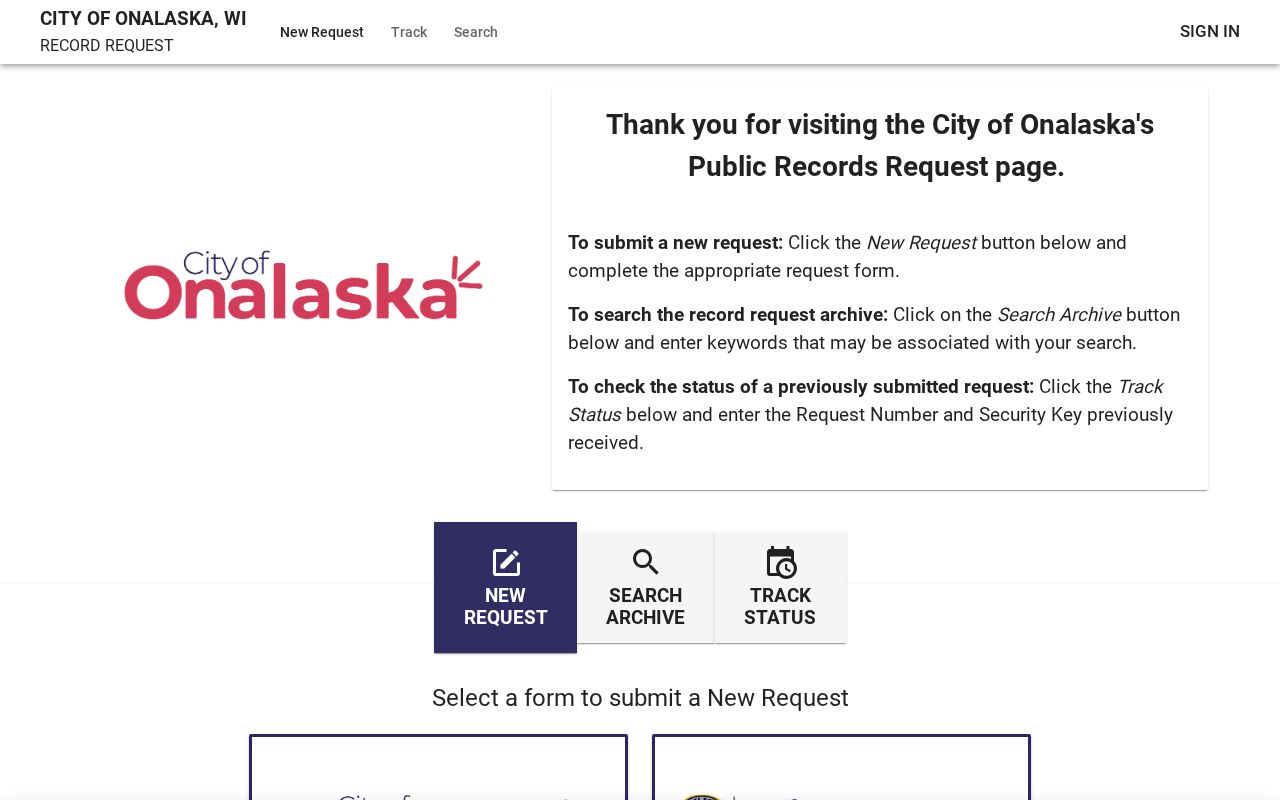
The portal image marks the correct city records channel. Give a precise incident, date range, location, and desired record type when the live form asks for them. A narrow request helps OPD distinguish a written report from video, photographs, or other media.
Records at the Onalaska Police Department
Onalaska Police Department is at 415 Main Street, Onalaska, WI 54650. Its main number is 608-781-9550, and the office is open Monday through Friday from 8 a.m. to 4 p.m. Shared nonemergency dispatch is 608-782-7575. Chief Tim Berg leads 31 officers and four civilian staff. The department dates to 1946, a useful marker when someone is tracing older local records.
The official OPD page supplies the department contact and service entry points. Police records are requested from OPD even though dispatch is shared with other agencies.
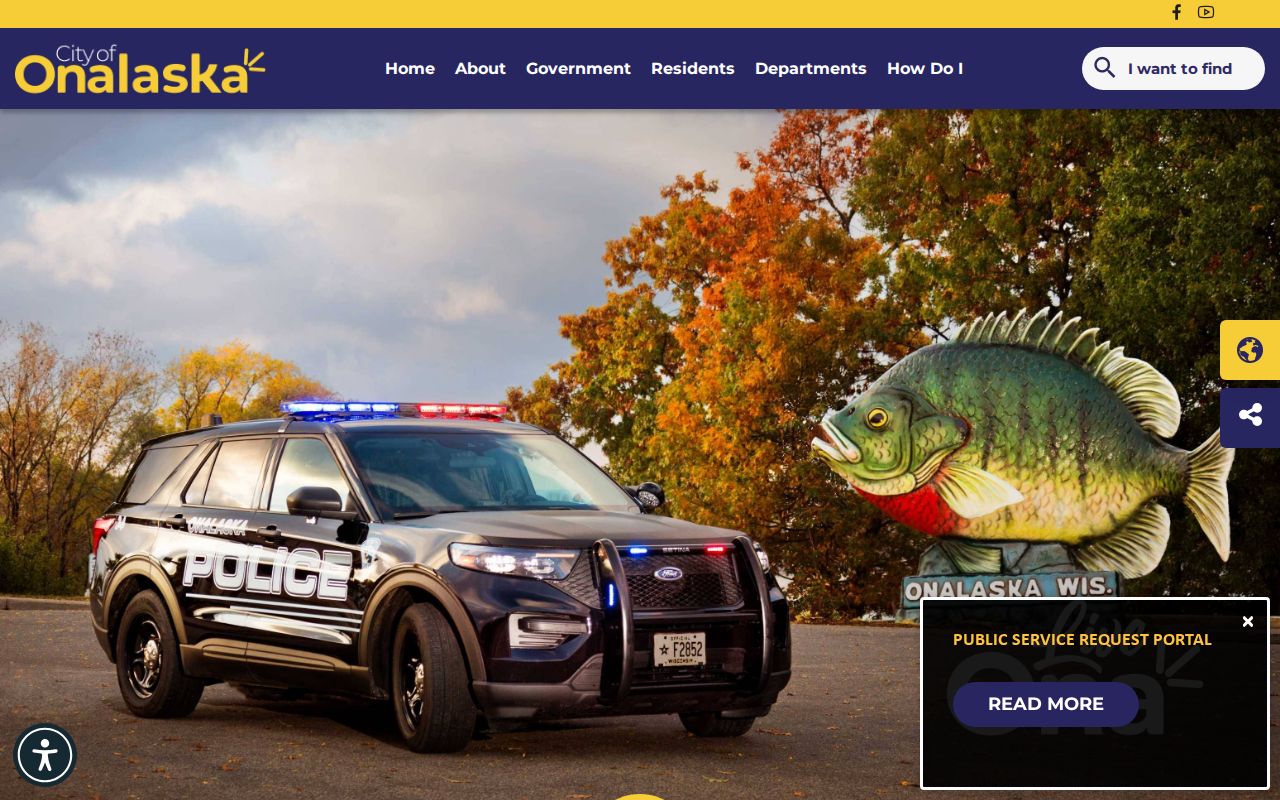
The department image anchors the city custodian. Calling county dispatch to send an Onalaska officer does not make the county the holder of that officer's report.
Onalaska's official staffing context is more reliable than an unsupported third-party crime total. The 31 sworn officers and four civilian staff serve a city that grew from 18,803 residents in the 2020 Census to an estimated 20,475 in 2025. The Wisconsin DOA municipal estimates support that city classification and figure. The 8.89 percent rise can increase service and records demand, but it does not measure crime. For current offense counts, use FBI Crime Data Explorer or Wisconsin DOJ reporting when available.
The department's 1946 start also helps date a historical request. A person researching an event from an earlier era should call OPD before filing through the modern portal and describe the year, names, location, and type of record. Onalaska marked its 175th anniversary in 2025, but city history and police-record retention are separate questions. The records custodian can say what older files remain and where an archived item is held.
Onalaska Online Incident Records
Onalaska's online incident route warns that processing may take several days. The person filing must give contact information so police can respond. A victim may be contacted for more detail, evidence, or a sworn statement. That follow-up can become part of the police record, so the online submission is the start of a report process, not an instant final document.
Businesses must call dispatch instead of using the online form. That limit is important. A business should not force an event into the public form when OPD directs it to the dispatch channel. Emergencies also belong with emergency services, not a delayed web submission.
Save the confirmation and any later message from OPD. Staff may ask for evidence or a sworn statement, and those items help complete the same Onalaska incident file. When requesting a copy later, provide the event date, location, and report reference rather than asking for a broad name search. The municipal clerk will not have the narrative unless a separate citation was filed in the joint court.
Onalaska also publishes separate official forms for a voluntary statement and a citizen complaint. Those forms serve different purposes from an incident report or a JustFOIA copy request. Use the channel that matches the action being taken, retain the submission receipt, and refer to the existing OPD report number when the statement or complaint concerns an event already reported.
Booking and Arrest Records in Onalaska
OPD does not publish a separate holding-facility roster. When an Onalaska arrest leads to custody, use La Crosse County's live inmate list. The city police report stays with OPD, while the county jail creates the booking and custody file. Current roster information can change with release or transfer and is not proof that a charge ended in conviction.
Next, search WCCA for a filed La Crosse County Circuit Court case. A prosecutor may file different charges from those first listed at booking, or may file none. The county's court case lookup provides more detail on the circuit record without turning this city page into a county-wide case manual.
Note: An Onalaska arrest may create city police, county booking, and circuit court records on different schedules.
Three Onalaska Record Types
A common error is treating every local result as the same criminal record. Onalaska's channels divide by custodian and legal stage. The city police file focuses on the reported event. The municipal file focuses on an ordinance or traffic citation. The county and state systems cover custody and state charges.
| Record | Holder | Best Use |
|---|---|---|
| Police report or media | Onalaska Police Department | Review the incident narrative, evidence, or response |
| Municipal citation | Coulee Region Joint Municipal Court | Confirm plea, balance, hearing, payment, or enforcement |
| Booking or state case | La Crosse County jail or Circuit Court | Check custody or the outcome of a filed state charge |
Search the row that matches the question. Absence from CCAP is expected for most Onalaska municipal citations, not proof that no city file exists.
The Onalaska Municipal Court File
The Coulee Region Joint Municipal Court sits in City Hall Council Chambers, Room 143, at 415 Main Street. The phone is 608-781-9558. Court supervisor Hildie McIntyre and Judge Nikki Swayne serve a court shared by Bangor, French Island, Holmen, Onalaska, Rockland, the Town of Shelby, and West Salem. Prosecutor Amanda Jackson handles Onalaska matters.
The court's official page identifies the joint arrangement and its city contact.
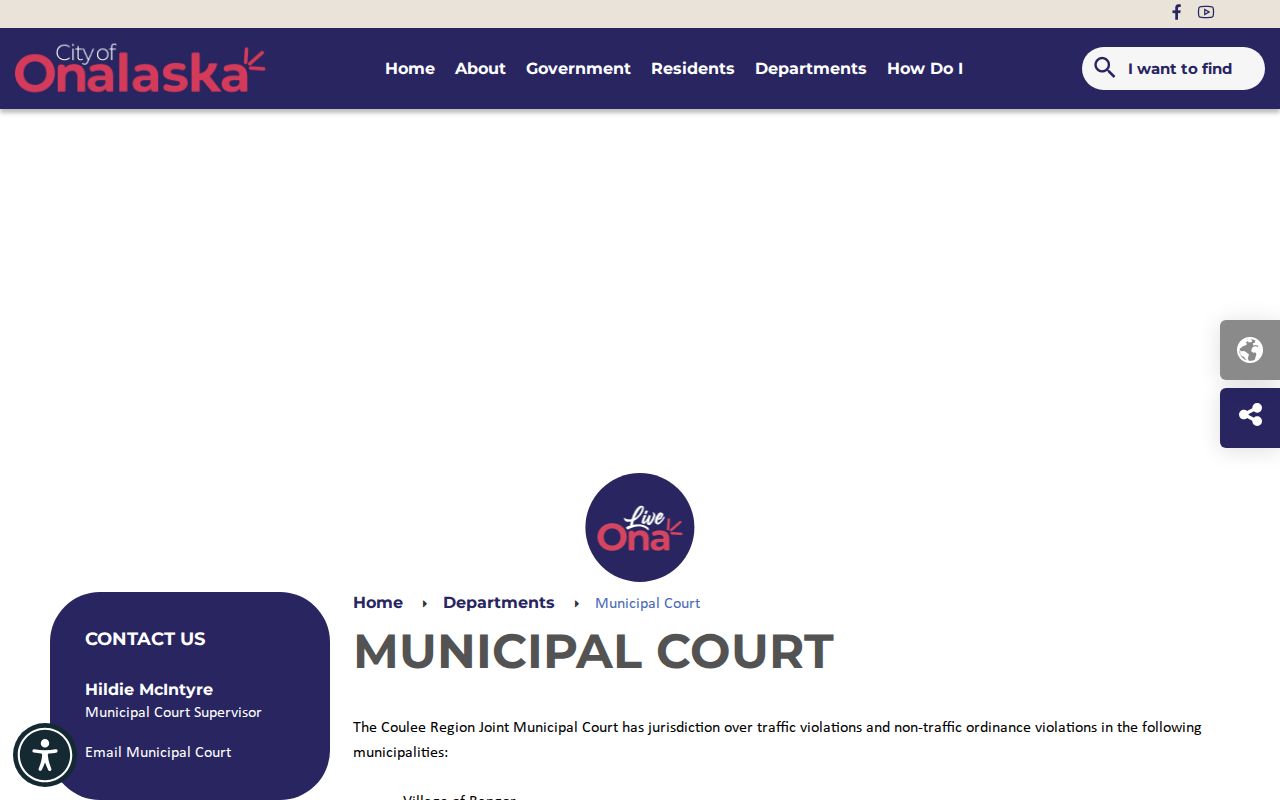
The court image points to one room serving seven communities. Its exclusive jurisdiction is forfeiture actions brought under member ordinances, resolutions, or bylaws.
| Court Name | Coulee Region Joint Municipal Court |
|---|---|
| Case Types Heard | Forfeiture actions under member-community ordinances, resolutions, and bylaws |
| Onalaska Lookup | Call 608-781-9558 with name and date of birth |
| Public Online Display | Generally absent from CCAP/WCCA |
| State-Court Exception | An OWI transferred at the defendant's request appears in Circuit Court |
Because the court serves seven places, say that the citation was issued in Onalaska when calling. The shared courtroom does not merge every member's police file. OPD still keeps its own report, and the joint clerk keeps the municipal proceeding. The name, date of birth, citation number, and issuing community help the clerk select the right record.
Onalaska Plea Record Route
A person in a nonmandatory case may enter a guilty, no-contest, or not-guilty plea online. The official Onalaska plea form is dynamic, so its current choices should be read on the live form. Paying the citation counts as a no-contest plea and waives appeal. That is a legal consequence, not just a payment choice.
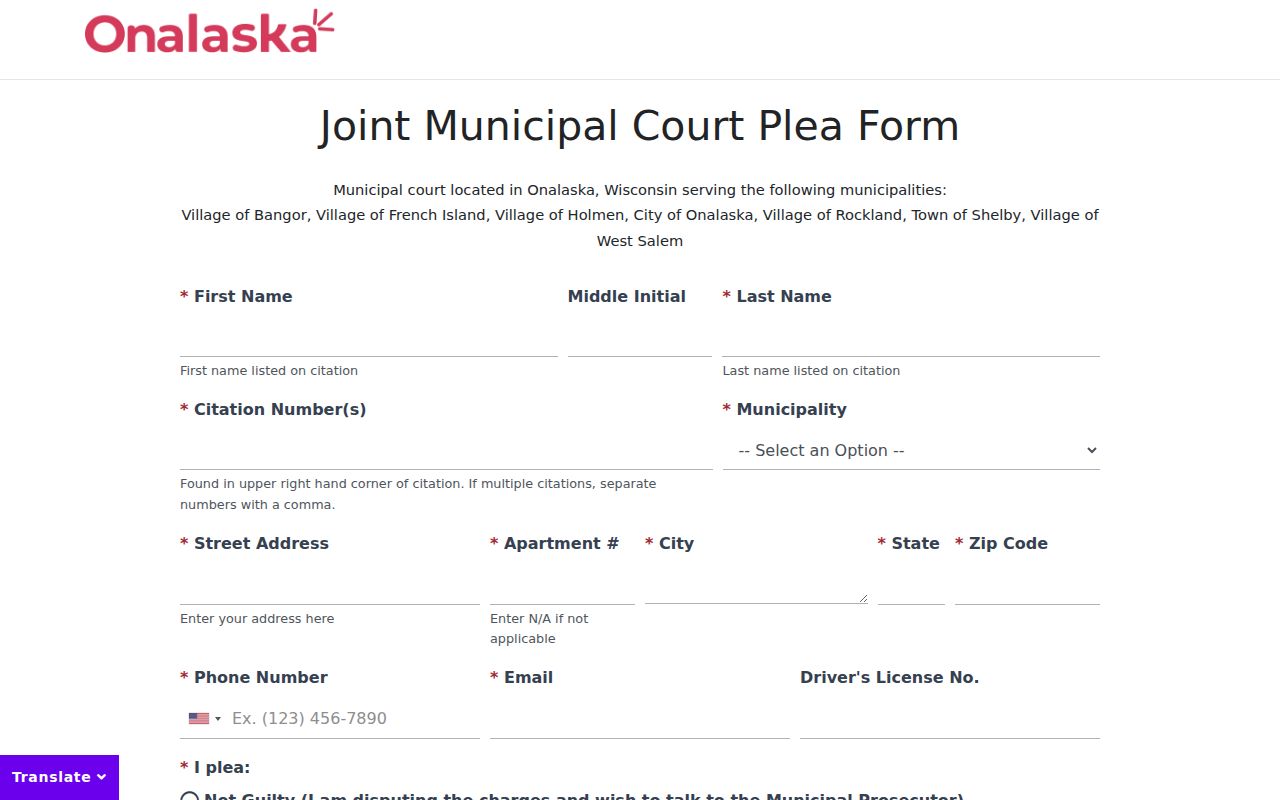
The plea-form image shows the online entry point. A not-guilty plea triggers an emailed pretrial scheduler. The prosecutor is not consulted at the initial appearance, so the next step comes through the court process rather than an immediate negotiation at that hearing.
Payments at the Treasurer may be made by cash, check, money order, cashier's check, or debit or credit card with photo identification. FivePoint is the court's online payment option.
Before paying, confirm the Onalaska citation and balance with the clerk. Payment is entered as no contest and gives up the right to appeal, while a not-guilty plea creates a different record path through pretrial scheduling. Saving the receipt and court email makes it easier to document which choice was entered and when.
Onalaska Citation Procedure Records
The joint court procedure explains why most municipal citations cannot be found through the usual statewide court search. It also describes pleas, pretrial scheduling, payment, enforcement, and appeal.
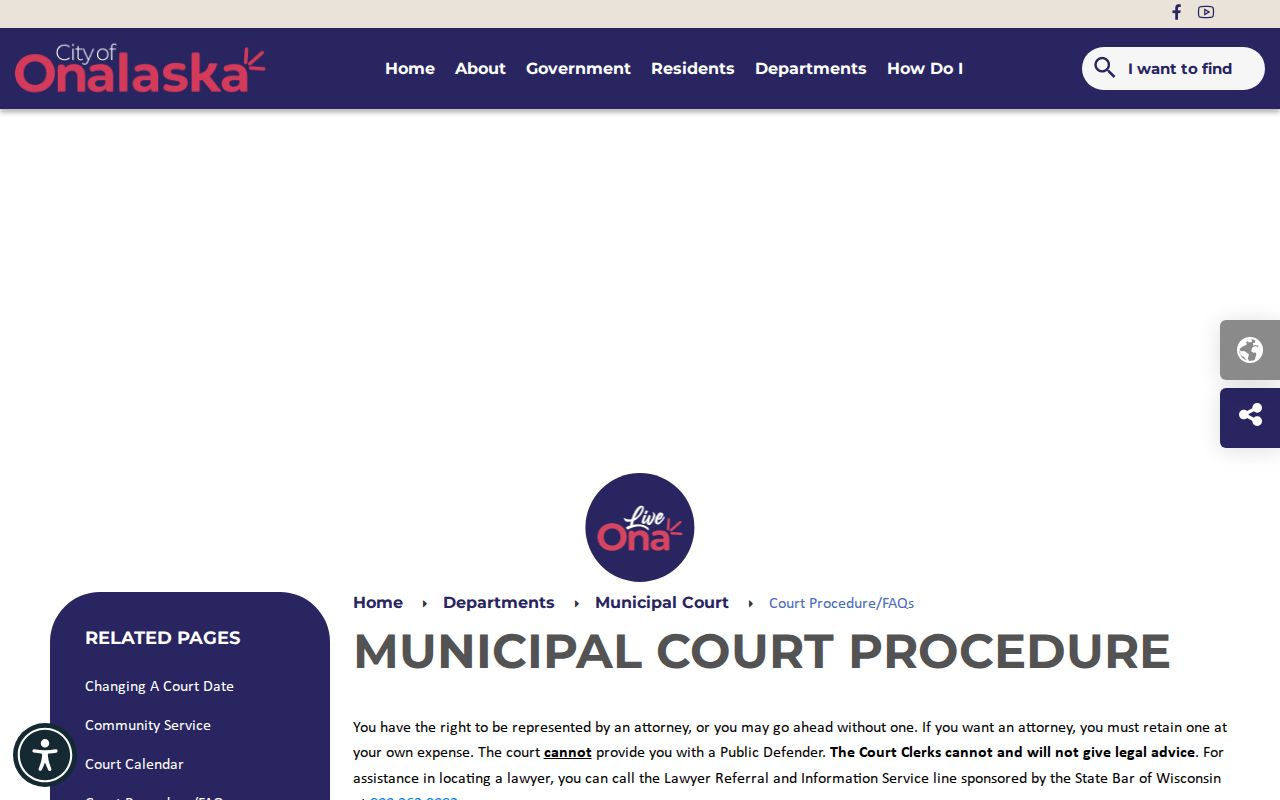
The procedure-page image captures a local exception that can trip up a searcher. For a lost citation or balance, call the clerk with the person's name and date of birth rather than relying on WCCA.
Municipal proceedings use the clear, satisfactory, and convincing evidence standard. That is a civil forfeiture burden below the criminal beyond-a-reasonable-doubt standard. The municipal court does not provide a public defender.
How Onalaska Records Reach the County
An OPD report remains a city record. If police make a custodial arrest, La Crosse County jail creates the booking. When the district attorney files a state charge, La Crosse County Circuit Court creates the court case. Courts later transmit qualifying dispositions and sentences to the Wisconsin DOJ Crime Information Bureau.
Record flow: Onalaska Police Department › La Crosse County Jail and Circuit Court › Wisconsin DOJ Crime Information Bureau
Municipal ordinance cases usually do not follow that full path. They remain in the Coulee Region Joint Municipal Court unless an event such as a defendant-requested OWI transfer creates a circuit matter. Check the city clerk before assuming a blank WCCA search is complete.
Onalaska Citation Enforcement Records
An unpaid Onalaska citation can move into several enforcement channels. Possible outcomes include license suspension, state debt collection, tax intercept, or county-jail commitment. Jail commitment requires an ability-to-pay process, and an indigency application and hearing may matter. Those later actions can add entries to the municipal file even though the original citation remains absent from public CCAP.
An appeal requires a written filing within 20 calendar days and full payment of the fee, forfeiture, and costs. Missing that short clock can close the ordinary appeal route. Contact the joint-court clerk promptly when a judgment, balance, or deadline is unclear.
Keep proof of the plea, payment, and any indigency filing. Those papers help the clerk locate the correct Onalaska citation record and show when an action was taken. They also help separate the court balance from a later state collection entry. If the issue is a lost citation, provide the clerk with the name and date of birth rather than searching unrelated circuit cases by name.
Onalaska Record Access Rules
Wisconsin Public Records Law governs requests to OPD and the municipal court, subject to statutory exclusions and the public-records balancing test. A custodian may redact protected personal information, victim or witness detail, juvenile material, or records whose release would harm an active investigation. State repository law separately controls the collection and dissemination of fingerprint-supported criminal history.
Key Statutes:
Wis. Stat. § 19.35 establishes inspection and copy requests, response duties, fees, and enforcement.
Wis. Stat. § 19.36 sets exclusions and special rules for personally identifiable and law-enforcement records.
Wis. Stat. § 165.84 requires designated arrest fingerprints and data to be submitted to Wisconsin DOJ.
Use a precise description and verify identity before relying on a result. Public access does not turn an arrest into proof of guilt, and it does not erase the difference between a city citation and a state conviction.